Evergreen Guide Choosing a tree
What Size Christmas Tree Should You Buy? Measure More Than Your Ceiling
A tree that looks modest among a hundred others can fill a living room. Here is how to measure so the one you carry home actually fits.
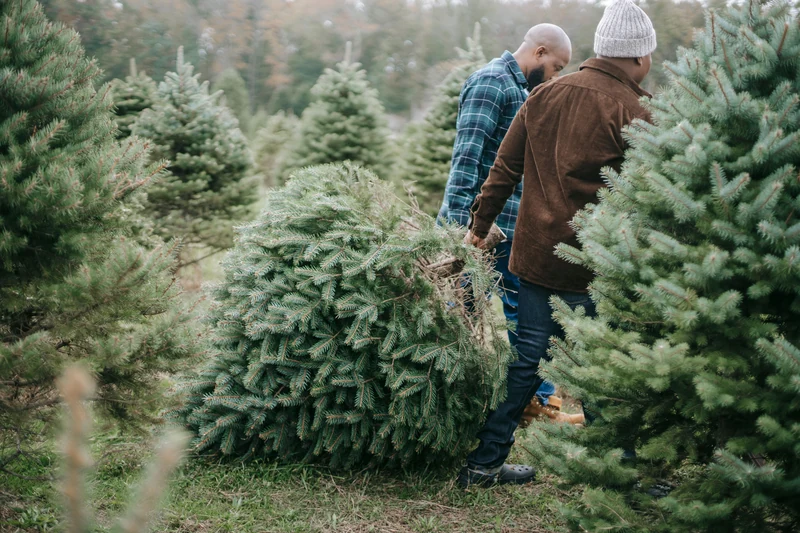
You find the tree at the top of a gentle slope, plump and perfectly shaped, and everybody in the family agrees it is the one. Then you carry it to the car and realize it is a lot taller than it looked out there under the open sky. A few minutes of measuring before you leave home would have told you exactly which tree to look for.
The short answer: take your ceiling height and subtract about 6 inches for the stand, about 6 inches of breathing room, and another 6 inches if you use a topper. For an 8-foot ceiling, that means a tree about 7 feet tall with no topper, or about 6 and a half feet with one. Then check the floor, because a farm tree is often about 80 percent as wide as it is tall. A stand that holds at least a gallon, or a quart for every inch of trunk, keeps it fresh.
How do you measure your ceiling for a Christmas tree?
Measure from the floor to the ceiling at the exact spot where the tree will stand, not in the middle of the room. Ceilings that slope, a beam, crown molding, a ceiling fan or a hanging light can cost you inches. If anything hangs down near the corner you have chosen, measure to the lowest point it reaches.
Write down two numbers before you leave the house:
- The tallest tree that will fit under the ceiling.
- The widest tree that will fit on the floor.
Also decide how the tree will be seen. A tree in front of a window should look good from all four sides. Against a wall it needs three good sides, and in a corner two. Keep it clear of heating vents, fireplaces, radiators and doorways.
How much height does the stand add?
A cut tree sits in a stand, and the stand lifts it. Most stands add about 4 to 10 inches, and 6 inches is a good planning number. The trunk also loses a thin slice when you make a fresh cut at home, which takes a little off, but not enough to count on.
If you already own a stand, measure it from the floor to the rim where the trunk will sit. If you are buying a new one, look at the listed height. Also look at the maximum trunk diameter it will accept. A stand that is too small for the trunk is a headache you do not want on Christmas Eve.
How much room should you leave for a topper?
Leave a little breathing room between the top of the tree and the ceiling, about 6 inches at a minimum. A tree that touches the ceiling gets bent, and its top shoot can be crushed. If you will put a star or an angel on top, add another 6 inches or so. Tall, wide toppers may need up to 10 inches more.
Here is the math in one line:
Tallest tree = ceiling height − stand − clearance − topper
For a 96-inch (8-foot) ceiling:
- No topper: 96 − 6 − 6 = 84 inches, or a 7-foot tree.
- With a topper: 96 − 6 − 6 − 6 = 78 inches, or about a 6-and-a-half-foot tree.
Ask the farm how it measures height. If the number is taken from the bottom of the cut to the top of the tree, it does not include your stand, which is why the stand comes out of the math above.
How wide is a Christmas tree?
Height is only half of the story. A tree’s width is set by its taper, which is how wide the bottom branches spread compared with how tall the tree is. Farm trees are commonly shaped to a width about 80 percent of their height. That means a 7-foot tree can be nearly 5 and a half feet across at the bottom, which is a lot of floor in a small living room. A slimmer tree, closer to two thirds as wide as it is tall, is about 4 feet 8 inches across at 7 feet.
Different kinds of trees have different shapes:
- Fraser fir is a neat pyramid. Farms used to grow wide, dense Frasers, and many now shape narrower ones for homes with less room.
- Douglas fir is full and symmetrical, a classic cone.
- Noble fir is tall and very symmetrical.
- Blue spruce is a narrow pyramid.
- Norway spruce is a cone with drooping branchlets.
- Pines are usually sheared into full, dense trees, and white pine can be very full.
- Leyland cypress is feathery and fairly upright. Blue Ice Arizona cypress is compact and columnar, while Carolina Sapphire is bushier.
Do a quick sum before you go. Take the tallest tree that fits and multiply by 0.8. If that is wider than your floor space, look for a slimmer shape or drop down a size.
Why do Christmas trees look smaller in the field?
Out in the field, the sky is your ceiling. A tree that looks about right among rows of its neighbors and under open sky can easily overwhelm a living room. It’s one of the most common mistakes families make, and it is why so many people go home with a tree that is too big.
The fix is easy and a little bit fun. Bring a tape measure, and better still, bring a pole or a stick marked at your maximum height. Stand it next to each tree you are considering. Let one person hold the pole, and have everyone else stand back and look. When you are tempted by something taller, hold the pole against it and be honest about what you see. If you will do the cutting yourself, tie a bright ribbon on the pole at the height you need, so you can find it from across the field.
Do not forget that the tree also has to travel. Measure the space in your vehicle, and think about the doorways and stairs it must go through. Many farms wrap the tree in netting, which makes it easier to carry and tie down, but a tall tree still needs room.
What size trunk and stand do you need?
Check the trunk before you commit. The base should be straight and have a bare “handle” of about 6 to 8 inches, so it fits in the stand. Pines often have a bit of a crook. If the handle looks too short, ask the farm to trim a few lower branches before you pay.
The size of the stand matters for freshness, not just for balance. A cut tree drinks water through its trunk, and the thicker the trunk, the more it can drink. As a rule of thumb, a stand should hold about a quart of water for every inch of trunk diameter, and at least a gallon for most trees. A trunk 3 inches across may drink about 3 quarts a day, and in the first day or so a fresh tree can take a full gallon or more.
Some practical points:
- Measure the trunk’s width at the base and match it to the stand’s maximum.
- Do not whittle or shave the sides of the trunk to make it fit, because the outer wood is where the tree takes up water.
- Pick a stand with a large water bowl. A bigger reservoir is a real advantage.
- Check the water every morning. If the water drops below the base of the trunk, the cut can seal over.
What size tree fits which room?
| Ceiling height | Tallest tree, no topper | Tallest tree, with topper | Widest at the base (80% of height, with topper) |
|---|---|---|---|
| 8 feet (96 in) | 7 feet (84 in) | 6 feet 6 inches (78 in) | About 5 feet 2 inches |
| 9 feet (108 in) | 8 feet (96 in) | 7 feet 6 inches (90 in) | About 6 feet |
| 10 feet (120 in) | 9 feet (108 in) | 8 feet 6 inches (102 in) | About 6 feet 10 inches |
| 12 feet (144 in) | 11 feet (132 in) | 10 feet 6 inches (126 in) | About 8 feet 5 inches |
A slimmer tree, about two thirds as wide as it is tall, is about 4 feet 8 inches wide at 7 feet tall and about 5 feet 8 inches wide at 8 and a half feet.
What if the tree turns out too tall?
It happens to nearly everyone at least once. A tree that is a bit too tall can be trimmed at the top or the bottom, and the boughs you cut off make lovely decorations for a mantel, a doorway or a porch planter. Take off the lowest branches if the handle is too short for your stand, and cut the leader if the top touches the ceiling. Do not shave the sides of the trunk to make it fit the stand, because that is where the tree drinks.
If the tree is too wide rather than too tall, turn its best side to the room and tuck the roughest side into a corner or against a wall. Trees that fit snugly into a corner only need two good sides, and a wall needs three, so a wide tree can sometimes be rescued by where you put it. A tree in front of a window is the hardest to place, because everybody sees every side.
Sloped ceilings and low beams need their own thinking. Measure the ceiling height right where the trunk will be, then check how far the tree’s top will lean or reach. A tree that fits at the trunk can still hit a slope a foot to the side.
Quick checklist before you leave home
- Ceiling height at the exact spot, and the lowest fixture above it.
- Tallest tree for that ceiling, with or without a topper.
- Widest tree for that floor space.
- Your stand’s height, maximum trunk size and water capacity.
- A tape measure or a marked pole, plus cord to tie the tree to the car.
- The size of your vehicle, doorways and stairs.
When in doubt, choose the smaller tree. A tree that is a little small is easy to fix with a few more lights, a tall stand or a fun topper. A tree that is too big means a trim, a tangle and lots of branches on the floor.
Where to find these farms
For the freshest tree, cut it yourself. These states have cut-your-own farms in our directory; open one to see them.
Cut your own 880 farms in 38 states
- Connecticut 96
- Wisconsin 95
- Ohio 81
- Massachusetts 78
- Virginia 69
- New Jersey 62
- Oregon 44
- Vermont 31
- Georgia 27
- Washington 23
- Texas 20
- Maine 17
- Maryland 16
- New York 16
- California 15
- Michigan 15
- Tennessee 15
- New Hampshire 14
- Illinois 12
- Alabama 11
- Florida 11
- Arkansas 10
- Iowa 10
- Pennsylvania 9
- South Carolina 9
- Indiana 8
- Kentucky 8
- North Carolina 8
- Minnesota 7
- Missouri 7
- West Virginia 6
- Colorado 5
- Kansas 5
- Oklahoma 5
- Louisiana 4
- Nebraska 4
- Rhode Island 4
- Mississippi 3