Evergreen Guide Choosing a tree
How to Tell If a Christmas Tree Is Fresh
A few simple tests in the first minute can tell you whether a tree will last through the holidays. Here is what to look, feel and smell for.
You are standing in front of a row of beautiful trees, and every one of them looks great from ten feet away. The difference between the one that stays lush until New Year’s and the one that drops needles by the second weekend is hiding in details you can check with your hands in about a minute. Here is what to feel for, what to sniff and what to ask.
The short answer: a fresh tree has needles that stay put when you pull a branch through your hand, only a few inner needles that fall when you bounce the trunk on the ground, a rich green color, a fragrance when you crush a needle, and a sticky cut at the bottom. Get it into water quickly, keep the stand full, and it will stay fresh for weeks and much safer in your home.
What is the quickest freshness test?
Start with the pull. Take a branch between your thumb and finger, hold it loosely and slide your hand outward along it, toward the tip. One or two needles may come off. If a handful comes off, the tree is not fresh. Needles should stay firmly attached when you gently tug them.
Then try the bounce. Lift the tree a few inches off the ground and drop it butt end first, or ask the farm to shake it. Some brown needles from the inside of the tree will fall, and that is normal. Very few green needles should come down. If a pile of green needles hits the ground, pick another tree.
How do you do the needle-bend test?
Give the branches a gentle bend. On a fresh tree, the needles are plump and springy and the branch flexes. A dry tree has brittle needles and branches that crack like a twig. If the needles crumble or break and leave little stubs, it is very dry.
Not every tree feels the same, so compare a few trees of the same kind:
- Spruce needles are naturally stiff and sharp, so they will not feel soft even when fresh.
- Pines are flexible.
- Firs are usually soft and pliable.
Look at how a tree feels next to its neighbors. The limp, rubbery one is thirsty, and the one that feels crisp and plump is probably the best bet.
What do color, smell and the cut tell you?
Color. A fresh tree is a healthy, rich green (or silvery blue, depending on the kind). A dull, lifeless look, or a bleached olive or gray-green, is a bad sign. Some lots spray a green or blue-green colorant on trees. It is harmless, but it can hide dry needles, so do the pull test anyway.
Fragrance. Crush a few needles in your fingers. Fresh needles are moist, slightly sticky and smell like evergreen. A musty smell is a warning.
The bark. Scrape a bit of bark from a small branch. Fresh wood looks a deep, wet green. Wrinkled bark or discolored foliage is not a good sign.
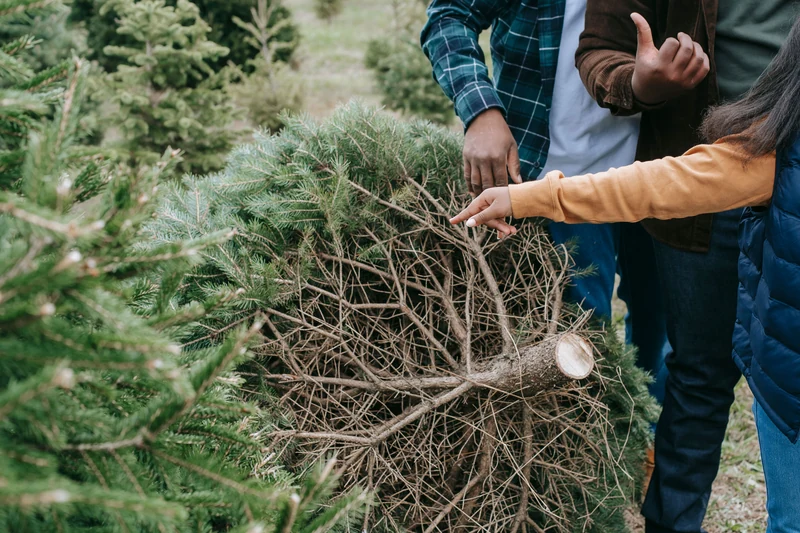
The cut. Look at the stump. A sticky cut with resin on it tells you the tree was cut recently and still has sap. A dry, dull stump suggests the tree has been sitting.
The weight. A fresh tree feels heavy for its size because it is full of water. The foliage should also feel cool to the touch.
What is normal needle shedding?
Every evergreen sheds some needles. Inside the tree, the oldest needles turn brown and drop, and you will see them when you shake or bounce a tree. Pines naturally drop their oldest needles in the fall, and many farms shake or blow them out before you leave. A little browning on the inside is fine.
What you do not want to see is needle loss on the outer branches, on the new growth, or green needles dropping when the tree is moved. That is a sign of a thirsty tree.
Does the kind of tree change the test?
A little. The tests above work on every tree, but the species can fool you in small ways.
- Firs hold their needles tightly, so a fir that sheds easily is a tree to skip.
- Pines shed more of their inner needles. Scotch pine keeps its needles even when it is dry, so a good grip on the needles does not prove the tree is full of water. Check the stump and the water level too.
- Blue spruce keeps its needles well only if it never runs out of water. After one dry spell, many needles fall.
- Leyland cypress dries out faster than a Fraser fir, so it is best cut at the farm and put in water the same day.
When you are not sure, ask the farm which of its trees tend to do best in a warm house. Farmers know their trees.
When was the tree cut, and does it matter?
It matters less than you might think. Most commercial trees are harvested in the first couple of weeks of November. A tree that was cut earlier and kept cool, shaded and moist can be just as fresh as a tree cut that morning, and good growers cut and bale quickly, then store trees in the shade near water. The real enemy is drying: a tree left in full sun or wind without water can lose up to half its water in a single day.
That is why a cut-your-own tree is the surest bet. It is cut the day you pick it, so you know exactly how long it has been without water. At a retail lot, you can still tell a lot by looking around:
- The trees stand in water, or on wet ground or damp mulch.
- The display area is shaded and out of the wind.
- The staff can tell you when trees arrive, and whether the lot gets one delivery or several. More than one delivery means trees that were cut more recently.
- Many of the trees were grown locally.
If the lot seems dry or the trees look tired, go somewhere else. When in doubt, choose another tree.
How do you get a fresh tree into water?
A tree that has just been cut can drink right away, but only as long as the cut stays open. When the base is exposed to air, resin seals the cut, and in just a few hours the tree stops taking up water.
Here is the quick routine:
- If the tree was cut more than half a day ago, ask the farm to cut a thin slice off the bottom, or do it at home. A slice about a quarter to a half inch thick is plenty. Cut straight across, not at an angle or in a V shape.
- If you will not put it up right away, stand it in a bucket of water in a cool, shaded place such as an unheated garage or the shady side of the house, out of the wind.
- Set it in a stand that holds at least a gallon of water.
- Fill the stand right away, and check it every day, especially in the first week. Never let it run dry. If it does, and the base has been dry for more than several hours, you may need another thin slice.
- Use plain water. Additives, sugar, aspirin, soft drinks and similar tricks do not help. Do not drill holes in the trunk or whittle the sides of it, either.
A very dry or very cold tree can take a day or two to start drinking. Be patient and keep the stand full.
What are the warning signs of a dry tree?
Check your tree at home, too. These signs mean the tree is drying out:
- Needles that are dry and brittle, or that break easily or come off in your hand.
- Heavy needle loss from the outer branches.
- Dull, faded color.
- A stand that stops getting emptier. A tree that drinks nothing may have a sealed cut.
- Water in the stand that is no longer touching the trunk. Check the base of the trunk, not just the bowl.
If your tree stops drinking, a fresh cut across the bottom is the fix. Taking a decorated tree down to do it is a chore, so check the water every day from the first morning.
Why is a fresh tree a fire-safety matter?
A well-watered tree is much harder to ignite than a dry one. In fire tests, a dry pine tree was fully on fire in less than nine seconds, while a well-watered one would not catch from a match or even from an electrically ignited matchbook. A propane torch lit a few branches, but the flames went out when the torch was removed. That is why a fresh tree and a full stand are the best safety measures you have.
A few good habits help:
- Keep the stand filled and check it daily.
- Keep the tree at least three feet from fireplaces, radiators, space heaters, candles and heating vents.
- Do not let the tree block an exit.
- Use lights that are in good condition and tested for safety, and turn them off when you leave the house or go to bed.
- Never put candles on a tree.
- A cooler room slows drying, and LED lights give off much less heat.
- Take the tree down after Christmas, or sooner if it has dried out, and keep it away from the house and garage until it is recycled.
A tree that is watered every day can stay fresh and safe for several weeks, but when the needles are dry, brittle or falling off in your hand, it is time for the tree to go.
Where to find these farms
For the freshest tree, cut it yourself. These states have cut-your-own farms in our directory; open one to see them.
Cut your own 880 farms in 38 states
- Connecticut 96
- Wisconsin 95
- Ohio 81
- Massachusetts 78
- Virginia 69
- New Jersey 62
- Oregon 44
- Vermont 31
- Georgia 27
- Washington 23
- Texas 20
- Maine 17
- Maryland 16
- New York 16
- California 15
- Michigan 15
- Tennessee 15
- New Hampshire 14
- Illinois 12
- Alabama 11
- Florida 11
- Arkansas 10
- Iowa 10
- Pennsylvania 9
- South Carolina 9
- Indiana 8
- Kentucky 8
- North Carolina 8
- Minnesota 7
- Missouri 7
- West Virginia 6
- Colorado 5
- Kansas 5
- Oklahoma 5
- Louisiana 4
- Nebraska 4
- Rhode Island 4
- Mississippi 3