Evergreen Guide Choosing a tree
Cut-Your-Own vs. Pre-Cut Christmas Trees: Which Is Right for You?
Hot cider and a saw in the field, or a quick stop at a lot? Here is how to decide, and what to bring either way.
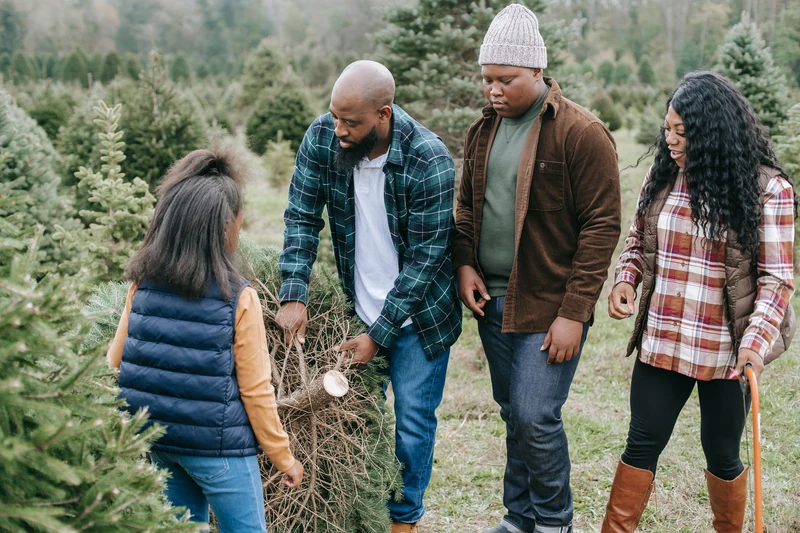
Picture it: a cold, bright Saturday, boots crunching along a row of trees, someone’s breath fogging in the air as the kids race ahead to find the perfect one. Now picture the other kind of Saturday, where you have an hour, a full calendar and a lot full of trees leaning in rows, ready to go home with you. Both are good ways to get a Christmas tree, and the right one depends on how you want your day to feel.
The short answer: cut-your-own is the best way to get a very fresh tree and a memory along with it. Pre-cut is the best way to save time and effort, and a good pre-cut tree can last just as long when you pick it carefully and take care of it. If you cannot or do not want to saw, many farms will cut a tree for you. If you want a tree for the yard afterward, a living tree is a third choice with its own rules.
What is the experience like at a cut-your-own farm?
At a choose-and-cut farm, you walk the rows, size up the trees and pick the one. You (or a helper) cut it down, carry or haul it to the processing area, and the farm cleans it up and nets it so it travels well. Many farms make a day of it with a wagon ride, a warm drink, a bonfire or a gift shop. You come home with a tree and a story.
It is the closest thing to picking a tree from your own backyard. You see how the tree grew, you check all sides, and you decide on the exact one that fits your family.
Which is fresher: cut-your-own or pre-cut?
A tree you cut yourself is harvested that same day, which makes it the most reliable path to freshness. It is already thirsty and ready to drink as soon as you get it in a stand.
Pre-cut trees can be just as good, but they vary more. Most commercial trees are harvested in the first couple of weeks of November, and some have been trucked in from other states. Trees that sit in the sun and wind without water can lose a lot of moisture fast. On the other hand, trees that have been stored in a cool, shaded place or displayed in water can be in very good shape, and a tree that was cut weeks ago is not automatically a bad one. What matters is how it was handled.
Here is how to get a good pre-cut tree:
- Shop where the trees stand in the shade, in water or on damp ground.
- Ask when the trees arrived and whether the lot gets one delivery or several.
- Ask where the trees were grown. Local is usually fresher.
- Run the tests in our guide to telling if a tree is fresh: a gentle pull on the needles, a bounce on the trunk and a bend of a branch.
- Go early in the season for the best selection, and expect lots to be a little easier on the budget in the last days before Christmas, though what is left may not be the best.
How much time and effort does each take?
Pre-cut is the winner on time. You park, pick, pay and go, often in under an hour. Someone loads the tree for you.
Cut-your-own takes longer, and that is part of the point. Plan on a couple of hours for the drive, the walk, the sawing, the hauling and the paperwork, and more if there is a hayride or a line at the shaker. It takes some work: you will be walking on uneven ground, and the cutting is easiest with two people. One saws while the other holds up the lower branches and gently tugs the tree away from the cut so the saw does not bind. Make the back cut first, then finish from the opposite side.
Where will you find the best selection and sizes?
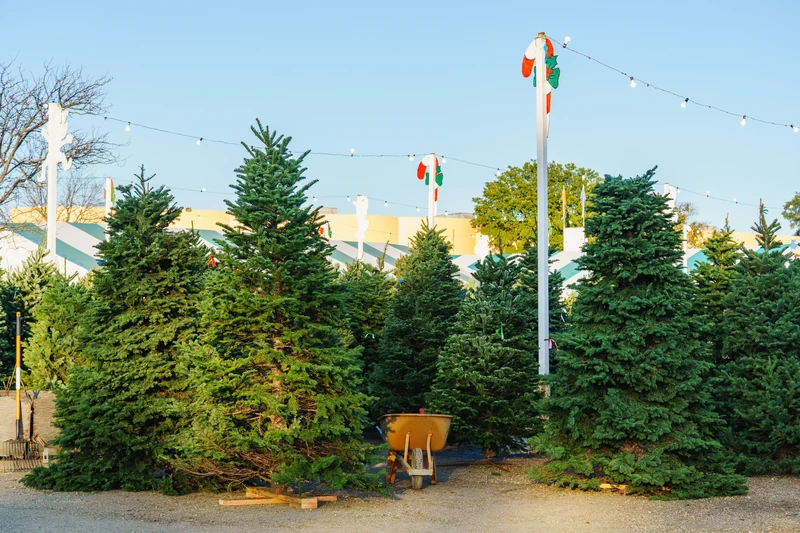
A big lot usually stocks a wide range of sizes and species, all lined up for easy comparison. You can see exactly what you are getting. Because lots restock, there is also a chance to pick up a tree later in the season.
A farm lets you walk among trees as they grew. The sizes run from small to very tall, and you can look at all sides, check the trunk and see the actual shape. Keep a few things in mind:
- Trees look smaller in a field than they do inside, so bring a tape measure or a marked pole. (Our guide to picking a size has the math.)
- Check that the trunk is straight and the bare handle at the bottom is long enough for your stand. Pines often have a bit of a crook.
- Some farms price trees one by one and some by the foot, so ask before you head into the rows. In general, the more picture-perfect the tree, the more it costs.
What help can the staff give you?
Ask the farm what it offers before you go. Many farms offer some mix of these services:
- Choose-and-we-cut. You pick the tree and a staff member cuts it for you. This is a great choice if you cannot saw or just do not want to.
- Shaking or blowing. A mechanical shaker knocks loose needles and debris, and some farms charge a fee.
- Netting or baling. Wrapping the tree makes it easier to carry and to tie onto your car.
- Loading. Some farms help carry or load the tree. Ask if you will need to tie it on yourself.
- A fresh cut. Some lots will make a fresh cut across the bottom of the trunk when you buy.
For Leyland cypress, a farm attendant usually makes the cut with a chainsaw.
What should you bring to a cut-your-own farm?
Dress for being outside, whatever the weather. Here is a short list:
- Comfortable, sturdy shoes or boots, and old clothes that can take a little sap.
- Gloves for whoever is cutting and loading.
- Rain gear if the sky looks iffy, and warm layers if it is cold.
- A tape measure or a marked pole, and the measurements for your space.
- Cord or ratchet straps to tie the tree to your car, and a tarp or old blanket to cover it on the drive home so it does not dry out in the wind.
- Your own saw if you like it better than the farm’s, though most farms provide one. Check the farm’s rules, because many do not allow chainsaws.
- A helper. Cutting and carrying are easier with two.
- A stand with a good-sized water bowl, plus a bucket of water if you will not set up the tree right away.
Watch your footing. Look out for stumps, vines, uneven ground and fire-ant mounds in warm parts of the country. Many farms do not allow pets, so ask first, and if dogs are welcome, keep them on a leash.
How do weather, terrain, kids and mobility change the choice?
Weather. Rain turns a field to mud, and snow makes hauling slower. A sled works well on snow, and a wagon or cart works on bare ground. Some farms offer a cart or a wagon, so ask if you need help. If the forecast is bad, a pre-cut lot under a roof may be the more comfortable option.
Terrain. Rows can be hilly, rutted or soft. If walking uneven ground is hard for you, ask whether the farm has flatter rows, a wagon ride out to the trees, or trees already cut and displayed near the barn.
Children. Kids love the hunt, and cutting your own tree can be the highlight of the season. Keep a close eye on children around saws and in the rows. Dress them for mud. If you have small children at home, keep in mind that spruce needles can be sharp, and soft-needled trees like Fraser, balsam, Douglas fir and white pine are friendlier.
Mobility. Choose-and-we-cut is a perfect answer when someone cannot walk the rows or saw. Many farms also sell trees that are already cut, so call ahead and ask what is easiest for your group. You can still enjoy the sights, the smell and the cider.
What about a living, potted tree?
A living tree, with its roots in a ball of soil or a pot, is a third option, and it is a good choice if you would like to plant a tree in your yard after the holidays. It takes a bit more planning:
- Keep it indoors for no more than about a week, and 10 days at the very most. A living tree that stays in a warm house too long can lose its dormancy and die.
- Keep it in a sheltered, unheated place such as a porch or garage until a few days before you decorate.
- Keep the root ball moist. Lift the tree by the ball or pot, never by the trunk, because it is heavy.
- After Christmas, let it get used to the cold for a few days outside, then plant it right away rather than waiting for spring. Dig the hole before the ground freezes, make it at least twice as wide as the root ball and no deeper than the ball, and mulch it with 2 or 3 inches.
- Choose a species that grows where you live, and make sure you have space for a full-grown tree.
Living trees usually cost more than cut trees, and some need delivery. Ask the farm which species it has and how big they get.
Which should you choose?
| If you want... | Best choice | Why |
|---|---|---|
| The freshest tree | Cut-your-own | Harvested the same day, and you can put it in water right away. |
| A family outing | Cut-your-own | The wagon, the cider and the hunt are part of the fun. |
| The quickest trip | Pre-cut | Pick, pay and load in under an hour. |
| The widest choice of sizes in one place | Pre-cut lot, or a big farm | Many sizes and species are lined up side by side. |
| Help with the work | Choose-and-we-cut, or pre-cut | Staff saw, shake, net and often load. |
| Bad weather or hard walking | Pre-cut, or choose-and-we-cut | Less time outside and less walking. |
| A tree for your yard | Living tree | Plant it right after Christmas. |
Whichever you choose, the same three things keep a tree fresh once it is home: a fresh cut across the base if the cut is more than a few hours old, a stand that holds at least a gallon of water, and a check of the water level every morning. After the holidays, many cities collect trees for chipping, or you can chip one for mulch or leave it in the yard as shelter for birds.
Where to find these farms
Every state we cover has farms of each kind. Open a state to see its farms with that option already selected.
Cut your own 880 farms in 38 states
- Connecticut 96
- Wisconsin 95
- Ohio 81
- Massachusetts 78
- Virginia 69
- New Jersey 62
- Oregon 44
- Vermont 31
- Georgia 27
- Washington 23
- Texas 20
- Maine 17
- Maryland 16
- New York 16
- California 15
- Michigan 15
- Tennessee 15
- New Hampshire 14
- Illinois 12
- Alabama 11
- Florida 11
- Arkansas 10
- Iowa 10
- Pennsylvania 9
- South Carolina 9
- Indiana 8
- Kentucky 8
- North Carolina 8
- Minnesota 7
- Missouri 7
- West Virginia 6
- Colorado 5
- Kansas 5
- Oklahoma 5
- Louisiana 4
- Nebraska 4
- Rhode Island 4
- Mississippi 3
Pre-cut trees 891 farms in 38 states
- Massachusetts 108
- Wisconsin 104
- Virginia 93
- Connecticut 88
- Ohio 79
- New Jersey 61
- Colorado 56
- Oregon 30
- Georgia 21
- Vermont 20
- Texas 17
- Washington 16
- Michigan 13
- California 12
- Maine 12
- New York 12
- Tennessee 12
- Maryland 11
- Florida 10
- Kentucky 10
- Pennsylvania 9
- South Carolina 9
- Alabama 8
- Illinois 8
- Indiana 8
- Iowa 8
- New Hampshire 8
- Minnesota 7
- Arkansas 6
- Missouri 6
- West Virginia 6
- Oklahoma 5
- Kansas 4
- North Carolina 4
- Mississippi 3
- Nebraska 3
- Louisiana 2
- Rhode Island 2
You choose, staff cut it 154 farms in 26 states
- New Jersey 22
- Massachusetts 18
- Oregon 16
- Wisconsin 14
- Ohio 13
- Georgia 10
- Iowa 8
- Connecticut 7
- Nebraska 7
- North Carolina 6
- Louisiana 5
- Virginia 4
- Kansas 3
- New Hampshire 3
- Alabama 2
- Arkansas 2
- Oklahoma 2
- Rhode Island 2
- Vermont 2
- Washington 2
- California 1
- Maryland 1
- Missouri 1
- New York 1
- Tennessee 1
- Texas 1