Evergreen Guide Caring for your tree
Real Christmas Trees, Pets and Small Children: A Safe and Happy Setup
A real tree and a curious cat, puppy or toddler can share a living room happily. Here is a calm checklist for setting it up safely.
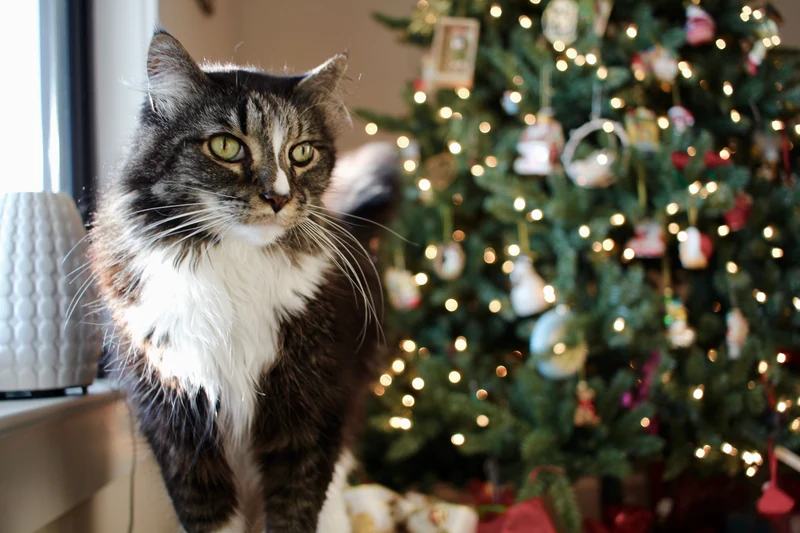
It is the first morning with the tree up. The house smells like a forest, the lights are on, and a small person is standing nose to nose with a low-hanging ornament while the cat watches from the couch with great interest. Real trees and curious little ones can get along beautifully. Most of what it takes is a few quiet choices on the day you set up, and most of the risks are small and easy to avoid.
The short answer: use a heavy, stable stand and anchor the tree so it cannot tip, cover or block the water, skip tinsel and sweep up needles, hang fragile and small ornaments high and soft ones low, hide cords and keep lights simple, and put a barrier around the tree if your pet or child cannot leave it alone. Plain water in the stand, with nothing added, is the safest water of all. If a pet eats something you are not sure about, call your vet right away.
How do you keep the tree from tipping over?
A tree is taller and heavier than it looks, and a cat who climbs or a toddler who tugs can bring one down. A stable setup is the most important step.
- Choose a stand with a wide, heavy base and a good-sized water bowl. A stand that is too small for the tree is a common reason trees fall.
- Make sure the tree is straight and snug in the stand before you let go. If the floor is uneven, put something flat under the stand to level it.
- Anchor the tree. Tie a wide, soft strap or cord from the trunk (not a thin branch) to a hook in a wall stud, and keep it out of the way. Avoid fishing line: it is nearly invisible, and pets and kids can get tangled in it.
- Add weight to the base, if your stand allows it, with a few clean stones or a weight made for the purpose.
- Place it thoughtfully. A corner, with the tree snug against two walls, is the steadiest spot. Keep it clear of doorways, and keep it away from heat vents, fireplaces and radiators.
Is the tree water safe for pets?
Plain water is the safest. The water in a tree stand can grow bacteria as it sits, and a pet who drinks it may get a mild upset stomach, with nausea or diarrhea. The bigger worry is anything you might have added. Fertilizers, preservatives, aspirin and sugar substitutes such as xylitol can be harmful, and a tree does not need any of them.
So put nothing in the water but plain water, and keep pets from drinking it:
- Use a stand with a cover, or a tree skirt that tucks closely around the base, so the bowl is blocked from pets.
- Wipe up spills, and change or top off the water every day.
- Keep an eye on a thirsty dog or cat, and make sure they have a fresh bowl of their own.
Your tree will be drinking for a good while, so a bowl of fresh water for the dog and cat is a good idea.
Are pine needles and sap a danger?
Mostly, they are a mild nuisance. The needles and sap of firs, pines and spruces contain oils that can irritate a mouth or an upset stomach if a pet chews on them, usually with drooling, vomiting or a lost appetite. A cat or dog would have to eat a lot to get seriously sick, but the needles are sharp, and a swallowed needle can scratch or poke the throat or gut.
A few easy habits help:
- Sweep or vacuum fallen needles every day. Pets that nibble tend to nibble what is on the floor.
- Wipe sticky sap off paws and fur with a damp cloth.
- Choose a tree that sheds less, if your pet chews. Firs generally hold their needles well, and some farms can tell you which of their trees tend to drop the fewest.
- Call your vet or an animal poison hotline if your pet eats needles or acts strangely, and keep the number somewhere you can find it quickly.
What decorations should you avoid?
Some of the prettiest decorations are the ones to be careful with.
- Tinsel and long garland. These are the most worrying item for cats. A cat who swallows a long, stringy piece can get a blockage in the gut that may need surgery. Skip tinsel completely, and choose wide ribbon, wooden beads or paper chains kept out of reach.
- Glass ornaments. A shattered ornament can cut a mouth or a paw and can be swallowed. Put them high up, and use shatterproof ones low.
- Ornament hooks. Small metal hooks are easy to swallow and easy to step on. Use ribbon loops or a closed-loop hanger instead.
- Edible ornaments. Candy canes, cookies, chocolate and popcorn strings smell wonderful to a dog. Some sweeteners, such as xylitol, are harmful to pets. Keep anything edible far above the floor, or leave it off.
- Salt-dough ornaments. They are very salty, and they can make a pet ill even when they are fully dry.
- Wrapped food gifts under the tree. A dog can smell chocolate and candy through the paper.
- Candles. Never put them on a tree, and never leave any candle burning where a pet can knock it over.
How do you handle lights and cords?
Chewed cords can cause shocks and burns, and they are one of the reasons to keep a close eye on a puppy.
- Use lights in good condition, with no frayed wires or cracked sockets, and don’t string together more than three sets of the old-style incandescent kind.
- Hide the cords behind the tree or along the wall, and cover them with a cord protector so they cannot be chewed.
- Try battery-powered lights with the battery pack tucked inside the tree, which lowers the risk. If a pet or child swallows a battery, go to the vet or the emergency room right away. Do not wait.
- Unplug the lights when you leave the house or go to bed.
What about toddlers and small children?
Children are fascinated by the tree, and the aim is to let them enjoy it safely.
- Dress the lower branches for little hands. Put soft, unbreakable ornaments, such as felt, wood, fabric and plastic ones, at toddler height. Hang glass, sharp and heavy ornaments, and anything with small removable parts, up high.
- Keep small things out of reach: tiny ornaments, beads, button batteries and anything a child can swallow or breathe in.
- Choose a softer tree. Fraser, balsam, Douglas fir and white pine have soft needles. Blue spruce needles are sharp and are a poor match for small children.
- Check the area under the tree. Leave room for presents, but keep the cords and small gift packaging out of reach.
- Teach them a simple rule, such as “we look with our eyes, and the tree is for grown-up hands only,” and give them a special job, such as hanging a paper chain.
- Keep the stand out of reach, with the water covered.
How do you stop a cat from climbing, or a puppy from chewing?
Cats. A tree is a very tempting tower. Give your cat something better to climb, such as a cat tree by a window, and a few toys. Use a gate or a pen to block off the room, or close the door when you are out. Make the tree less tempting by keeping the lower branches bare, and ask your vet about deterrent sprays that are safe for cats.
Puppies. Chewing is how a puppy explores. A baby gate or a play pen around the tree keeps them out. Practice a calm “leave it,” reward them for walking away and let them have lots of chew toys to chew on instead. Never leave an unsupervised puppy alone with the tree.
If you cannot make the space safe, put the tree in a room with a door and close it when you are away. This is not a failure; it is just a good plan.
What about allergies?
A true allergy to a real tree is rare, but some people sneeze, cough or get itchy eyes when a tree comes inside. The usual culprits are dust, pollen and mold that came in on the tree, and mold can keep growing indoors. A few steps help:
- Ask the farm to shake the tree, or shake it outside yourself.
- Rinse the tree with a hose outdoors and let it dry fully before it comes in.
- Take the tree down promptly after the holidays.
- Run an air purifier in the room, and change your clothes after decorating if you are sensitive.
- If someone has shortness of breath, swelling or a rapid heartbeat, call for help right away.
If strong scents bother someone, a tree with little aroma, such as white pine, or a tree with no sap, such as Leyland cypress, may be a good fit.
A calm checklist
- A heavy, stable stand, anchored with a soft strap.
- Plain water only, with the bowl covered.
- No tinsel, no edible ornaments and nothing breakable down low.
- Cords hidden, lights off when no one is home.
- Fallen needles swept up daily.
- A gate or a closed door if your pet or child cannot leave it alone.
- The number of your vet and an animal poison hotline where you can see it.
Most of this takes about an hour on the day you decorate, and then you can relax and enjoy your tree.